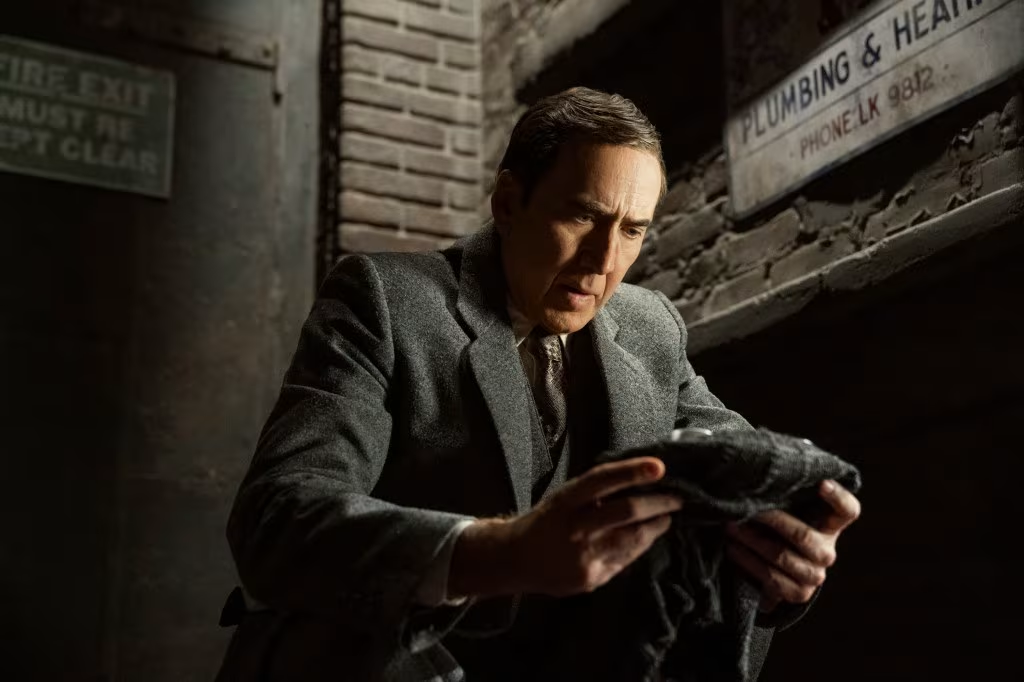
Nicolas Cage Says One Season Was Perfect After Spider-Noir Cancellation
Nicolas Cage has responded to Prime Video’s decision to cancel Spider-Noir after one season, saying he is satisfied with the eight-episode run and the story he wanted to tell as the Marvel character. The actor said the series achieved what he intended and described the single season as a complete creative statement.
Cage Responds to the Cancellation
Spider-Noir was canceled by Prime Video on September 4, just over three months after its May premiere. Cage addressed the decision in a statement to Deadline, saying, ‘For me, one season is perfect, having said what I wanted to say with this dangerous, innovative, pop-art Spider-Man. Onwards, upwards, inwards.’
The series marked Cage’s first regular television role. He played Ben Reilly, a private investigator in 1930s New York who is forced to confront his past as The Spider after a personal tragedy.
Cage had already indicated before the cancellation that he was unsure whether the series would continue. In an interview with Variety around the show’s release, he said, ‘I do not know. But I would say that whether it happens or not, all of us achieved what we set out to do, and it works on its own. We’ll see what happens.’
Spider-Noir Earned Strong Reviews
The cancellation came despite a strong critical response. Spider-Noir held a 92% critics score on Rotten Tomatoes around the time of the cancellation and received 11 Primetime Emmy nominations, the highest number for any Prime Video series this year.
The nominations included categories for production design, cinematography, sound, visual effects, stunt performance, stunt coordination, prosthetic makeup, music composition and title design.
The series also recorded significant viewing figures. According to Nielsen Streaming Content Ratings, Spider-Noir generated 2.6 billion viewing minutes in the United States during its first six weeks.
The Series Was Released in Two Versions
Spider-Noir premiered on MGM+ on May 25 before arriving on Prime Video shortly afterward. Viewers could watch the eight-episode series either in color or in black and white, reflecting its film-noir visual style.
The cast alongside Cage included Lamorne Morris, Li Jun Li, Karen Rodriguez, Abraham Popoola, Jack Huston and Brendan Gleeson. Oren Uziel and Steve Lightfoot served as co-showrunners and executive producers, while Phil Lord, Christopher Miller and Amy Pascal were among the executive producers involved in developing the series.
Cage’s portrayal of Spider-Man Noir also continued a character he first voiced in the 2018 animated film Spider-Man: Into the Spider-Verse. Spider-Noir gave him the opportunity to play the character in a live-action television series.
High Production Costs Reportedly Factored Into the Decision
While Prime Video has not publicly provided a detailed reason for the cancellation, reports have pointed to the show’s high production costs and the scale of its viewing performance. The series required production of both color and black-and-white versions, adding to the cost of the project.
Spider-Noir initially reached No. 2 on Nielsen’s U.S. Top 10 for original streaming series in its first week, with 851 million viewing minutes. Its viewing total later reached 2.6 billion minutes over six weeks, but the series reportedly did not maintain the same level of visibility on Prime Video’s daily rankings.
The cancellation also ends the first released project from Amazon MGM Studios and Sony Pictures Television’s agreement to develop live-action series based on Marvel characters controlled by Sony. Another project from the partnership remains in development.
All Eight Episodes Remain Available
Although there will be no second season, all eight episodes of Spider-Noir remain available to stream on Prime Video. The series ends with its first season as its complete run, while Cage has indicated that he is ready to move on from the character.
As of September 7, 2026, Prime Video has not announced plans to reverse the cancellation, and Cage’s latest statement confirms that he considers the one-season run a finished chapter.